If you pulled up Kaka'ako condo data this spring, you saw something that shouldn't be possible. Over the three months ending March 2026, the median sale price in the neighborhood climbed 9.1 percent year over year to $753,000. In that same window, the median price per square foot fell 22.6 percent. Prices went up. The cost per foot went down. Both numbers came from the same set of closed sales.
That's not a data error, and it's not a sign that Kaka'ako can't decide whether it's hot or cooling. It's the fingerprint of a program most buyers researching this neighborhood have never heard of, and understanding it is the difference between reading Kaka'ako's numbers correctly and reading them backward.
A Median Price Averages Whatever Sold
A median price tells you the midpoint of what closed. It says nothing about square footage, unit mix, or which building the sale happened in. Price per square foot is supposed to correct for that by normalizing to size, which is why the two usually move together. When they split this hard, the cause is almost always a shift in what kind of units are trading, not a shift in what any single unit is worth.
In Kaka'ako, that shift has a name: the Hawai'i Community Development Authority's Reserved Housing program. Residential projects subject to the program are required to set aside at least 20 percent of their units, for sale or rent, for households earning between 80 and 140 percent of Honolulu's area median income. Those units sell at prices set by the program, not at whatever the open market would bear. When a wave of them closes, they land in the same MLS dataset as $2 million ocean-view units at Ward Village, and the blended price per square foot drops even as total dollar volume on the market-rate side keeps climbing.
Two Master Plans, Two Very Different Price Tags
Kaka'ako's new construction runs through two master-planned pipelines, and they sit on opposite sides of this split.
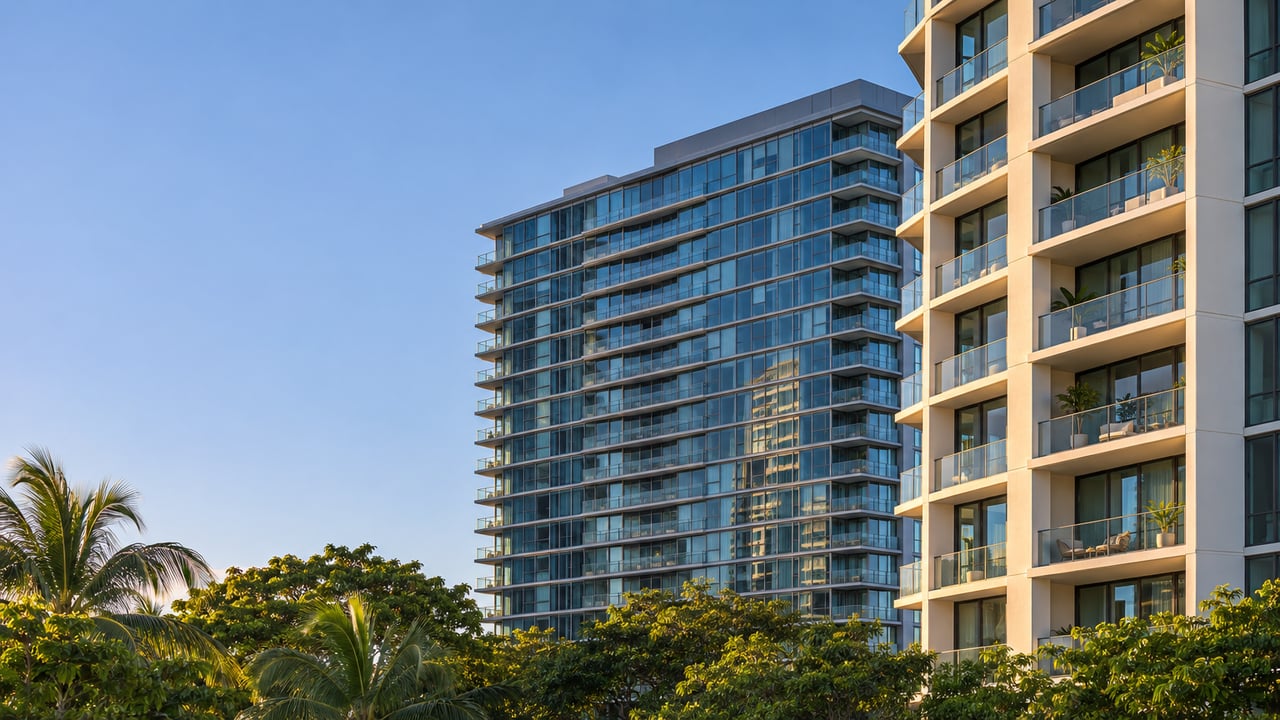
Ward Village, Howard Hughes' front-row development along Ala Moana Boulevard, is where most of the market-rate volume comes from. Ālia, the Kobayashi Group's 39-story tower, had reached level 29 of 39 by spring 2026 and was about 86 percent sold. Kalae, at 1000 Ala Moana Boulevard, was roughly 85 percent sold as of June 2026. The Launiu, an Arquitectonica-designed coastal modern tower, was actively selling. These are large, high-total-price units in resort-amenity buildings, and they're the ones pulling the median sale price up.
Our Kaka'ako, led by Kamehameha Schools on the Downtown side of the district, carries a larger share of reserved and workforce housing. Kahuina, a 43-story Stanford Carr project with 859 condos, set aside 396 of those units as reserved housing when sales launched in 2025, with completion estimated around 2030. Waiakoa, another project in the pipeline, has roughly 60 percent of its units designated affordable. Ulana Ward Village, a fully reserved-housing tower, sold out and delivered in November 2025, meaning a concentrated batch of below-market closings hit the resale and closing data right around the window this year's numbers are drawn from.
| Tower | Master plan | Unit mix | Status as of 2026 |
|---|---|---|---|
| Ālia | Ward Village (Howard Hughes) | Market-rate, 457 units | ~86% sold, level 29 of 39 |
| Kalae | Ward Village (Howard Hughes) | Market-rate | ~85% sold |
| The Launiu | Ward Village (Howard Hughes) | Market-rate | Actively selling |
| Kahuina | Our Kaka'ako (Kamehameha Schools) | 396 of 859 units reserved | Sales launched 2025 |
| Waiakoa | Our Kaka'ako (Kamehameha Schools) | ~60% affordable | Pre-construction |
| Ulana Ward Village | Ward Village (Howard Hughes) | 100% reserved housing | Sold out, delivered Nov. 2025 |
A buyer comparing "Kaka'ako price per square foot" against another neighborhood's number is often comparing a blend that includes income-restricted housing against a number that doesn't. That's not a fair comparison, and it's not one the raw statistic will ever flag for you.
What the Reserved Housing Rule Actually Restricts
The mechanism matters because it doesn't just explain a statistical quirk. It changes what a unit is and isn't for a given buyer.
To qualify for a reserved unit, a household generally needs to earn no more than 140 percent of the area median income, a threshold set annually using HUD's Honolulu County figures. For 2026, HUD set that county median at $133,400 for a four-person household, and HCDA's 140 percent cap for a four-person household worked out to $186,750. Buyers also have to meet additional program requirements.
The restrictions don't end at closing. The unit stays under a regulated term, during which HCDA has a first option to purchase if the owner wants to sell. Owners may also face resale restrictions. None of that applies to a market-rate unit at Ālia or Kalae. Two condos in the same Kaka'ako zip code, purchased in the same year, can carry completely different resale rules depending on which side of that 20 percent line they fell on.
The Slower Number: Days on Market
There's a second figure in the same dataset worth sitting with. Kaka'ako condos took an average of 71 days to sell in the recent reporting window, down from 111 days a year earlier. That's real improvement. It's also slower than Oahu's islandwide condo median of 38 days for closings in July 2026, according to Honolulu Board of Realtors data.
Volume tells a similar story. Twenty homes sold in Kaka'ako in March 2026, down from 33 in March 2025. Fewer transactions, at a slower pace than the island average, alongside a rising median price, is not the profile of a market simply heating up. It's closer to a market where fewer but larger, pricier units are closing while the smaller and reserved-housing side of the ledger, which tends to move faster once a lottery or offering window opens, cycles through in bursts tied to construction completions rather than steady month-to-month demand.
The market-rate side of Kaka'ako is pricing like a tighter market. The reserved-housing side is pricing like a program, not a market at all. The blended statistics you see on a portal are an average of two things that don't behave the same way.
What This Means If You're Comparing Kaka'ako to Somewhere Else
If you're weighing Kaka'ako against Ala Moana, Waikiki, or another Honolulu neighborhood on price alone, the question worth asking isn't "what's the price per square foot" but "what share of recent closings in that number were reserved housing." A tower with no set-aside units, like most of the front-row Ward Village stock, will price and behave differently than a blended district average suggests. A tower with a large reserved share, like Kahuina, will show soft per-square-foot numbers that have nothing to do with whether the market-rate units nearby are holding value.
The next reserved-housing offering expected in Kaka'ako is Mahana Ward Village, anticipated in late 2026 though not yet formally announced as of this writing. When it opens, expect the same pattern to repeat: a burst of below-market closings that will make the neighborhood's blended price per square foot look softer in the data even as the market-rate towers around it continue setting new highs on a per-unit basis.
Knowing which number you're reading, and which side of Kaka'ako's split it's describing, is the difference between an accurate read on the market and a statistic that happens to be true and still misleading.
If you're weighing a Kaka'ako condo against other Oahu neighborhoods, or trying to figure out whether a specific tower's pricing reflects the market-rate side or the reserved-housing side of this split, Real Select Vacations can walk through the specific building and the numbers behind it with you. Let's Connect.
This article is general information, not legal, tax or financial advice. Consult a qualified professional about your situation.